The Campaign Brief Problem
Every marketer knows the pain. You need a campaign brief by tomorrow. The strategy deck needs audience segments, channel recommendations, messaging frameworks, budget considerations, and success metrics. Normally this takes a full day of research, writing, and formatting. But it doesn't have to.
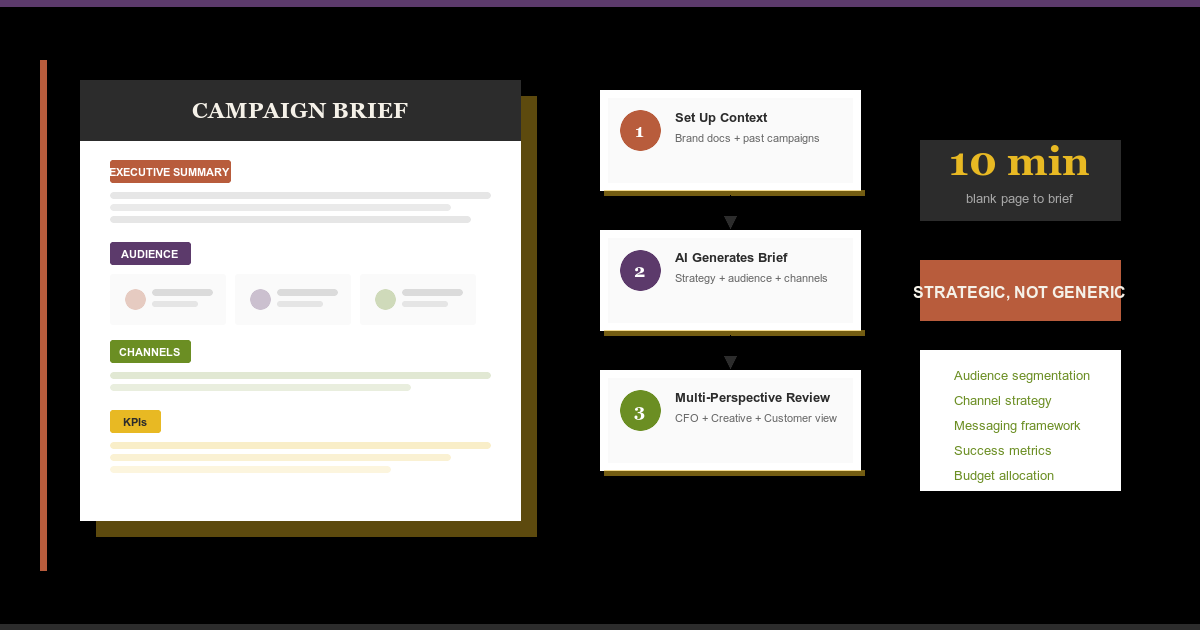
With Claude Code, you can produce a complete, strategic campaign brief in under 10 minutes. Not a vague outline — a structured document with executive summary, audience analysis, channel strategy, creative direction, and measurement framework.
What Makes a Great Campaign Brief
Before we automate anything, let's define what we're building. A great campaign brief answers six questions.
Who is the audience? What are their pain points, motivations, and media habits? What is the campaign objective? Brand awareness, lead generation, product launch, or re-engagement? What channels will we use and why? What is the core message and how does it adapt across touchpoints? What does success look like and how will we measure it? What is the timeline and budget framework?
Most AI chat tools give you a generic template. Claude Code gives you a strategic document because it reads your existing brand materials, competitive research, and past campaign performance before writing a single word.
Step-by-Step: Your First AI Campaign Brief
Step 1: Set Up Your Project
Create a folder for your campaign. Add any existing materials — brand guidelines, audience research, competitive analysis, past briefs that worked well. Claude Code reads all of this automatically.
You do not need to upload files to a chat window. Claude Code reads them directly from your computer. This is the fundamental difference from chat-based AI tools.
Step 2: Describe Your Campaign
Open your terminal, navigate to your project folder, and type claude. Then describe what you need in plain English.
Tell Claude your product, your target audience, your campaign objective, your timeline, and any constraints. Be specific about what matters — if you need to focus on enterprise buyers, say so. If you have a limited budget, mention it. The more context you provide upfront, the better the output.
Step 3: Review the First Draft
Claude Code produces a structured brief with all six components. The first draft typically includes an executive summary with campaign rationale, detailed audience segmentation with personas, channel strategy with budget allocation recommendations, messaging framework with key messages per audience segment, creative direction notes, and a measurement framework with KPI targets.
Step 4: Refine with Multi-Perspective Feedback
This is where Claude Code shines. Instead of revising blindly, you can ask Claude to review the brief from multiple perspectives. Ask it to critique the brief as a CFO focused on ROI. Then as a creative director focused on brand voice. Then as the target customer reading the messaging for the first time.
This multi-perspective approach catches blind spots that single-pass writing always misses. The CFO perspective tightens the business case. The creative perspective sharpens the messaging. The customer perspective eliminates jargon and clarifies the value proposition.
Step 5: Export and Share
The finished brief lives in your project folder as a clean, formatted document. Share it with your team, present it to stakeholders, or use it as the foundation for your creative production workflow.
Real Example: B2B Product Launch Brief
Here is what a Claude Code campaign brief looks like in practice. For CC4.Marketing's course, we built a sample campaign for a fictional B2B product called Planerio — an enterprise project management tool that coordinates team focus time.
The AI-generated brief included three distinct audience personas with behavioral insights, a four-channel strategy (LinkedIn, email, content marketing, and paid search) with specific budget split recommendations, messaging tailored to each persona's primary pain point, a 90-day timeline with weekly milestones, and success metrics tied to pipeline generation rather than vanity metrics.
The entire brief took 8 minutes from blank page to final version. A human marketer then spent 15 minutes refining the strategic positioning — a total of 23 minutes for a document that typically takes a full workday.
Common Mistakes to Avoid
Do not skip the context step. The quality of your brief depends entirely on the quality of your input materials. If Claude Code has your brand guidelines, past campaign data, and competitive research, the output is dramatically better.
Do not accept the first draft without the multi-perspective review. The first draft is always good. The reviewed version is always significantly better.
Do not treat the AI output as final copy. Claude Code produces strategic frameworks and strong first drafts. The human marketer's job is strategic judgment — deciding which positioning angle to lead with, which audience segment to prioritize, which channel to invest more heavily in.
Why This Matters for Your Team
Marketing teams that adopt AI-assisted briefing report three consistent outcomes. First, brief quality improves because the AI ensures no strategic component gets skipped. Second, turnaround time drops by 80 percent, freeing marketers to spend more time on strategy and creative review. Third, consistency increases across campaigns because every brief follows the same strategic framework.
The campaign brief is the foundation of every successful marketing initiative. When your briefs are stronger, everything downstream — creative production, media planning, content creation — gets better too.
Learn the Full Workflow
This brief generation process is taught in detail in Module 2 of CC4.Marketing, a free interactive course that runs inside Claude Code itself. Lesson 2.1 walks you through writing a complete campaign brief from scratch, with real-time AI assistance and multi-perspective feedback loops.
Start the course at cc4.marketing. No coding experience required.